
Digital Marketing for Restaurants in Delhi: Beyond Swiggy and Zomato
Walk into any popular café in Hauz Khas on a Saturday evening and you’ll notice something interesting. Nearly every table is occupied, and yet the owner claims the margins are tighter than ever. Ask why, and the answer invariably circles back to the same two names – Swiggy and Zomato.
There is no denying the positive impact these platforms have had on the restaurant industry in Delhi and across India. LinkedIn News shows that ₹1.9 lakh crore was spent on food through UPI payments in just the first half of FY26, that’s a 34% Y-o-Y increase. The aggregator platforms brought convenience at scale, gave small kitchens in Rajouri Garden access to customers in Dwarka, and helped cloud kitchens launch without a single square foot of dine-in space. For many restaurants, these platforms were and are a lifeline.
But a lifeline is not a business model.
When your restaurant pays 25% to 30% commission on every order, runs on an algorithm you cannot control, and has no idea who your customers actually are, you do not own your growth, you rent it. And the rent keeps going up!
If you want to own your visibility, digital marketing for restaurants in Delhi is no longer optional. It is the difference between a restaurant that survives on platforms and one that owns a brand that customers come back to. This guide will show you exactly how to turn your restaurant into a brand – channel by channel, strategy by strategy.
The Hidden Cost of Depending Only on Swiggy and Zomato
There is an obvious and a not-so-obvious cost to using food delivery platforms like Swiggy and Zomato. Let’s unpack them.
The Obvious But Staggering Cost of Commissions
Let us do some honest math.
If your restaurant does ₹5 lakh in monthly delivery revenue through aggregator platforms at a 28% commission, you are handing over ₹1.4 lakh every single month. That’s ₹16.8 lakh a year, before accounting for packaging, discounts, or the Gold and Pro memberships the platforms nudge you to buy.
The Not-So-Obvious Cost of No Customer Database
But commissions are only one part of the cost. The customer who orders biryani from your Connaught Place kitchen every Friday night is Zomato’s customer, not yours. You cannot reach them directly, offer them a loyalty deal, or even thank them.
At some point, if you decide to get off Zomato or Swiggy platforms, you have to give up all your customers on these platforms, and your competitors would be all too happy to scoop them up. That is the hidden cost of getting most of your business from these platforms.
Local SEO Strategies That Bring Customers to Your Restaurant
Restaurant SEO in Delhi is less about competing globally and entirely about winning locally. When your ideal customer is 3kms away and hungry, your goal is to appear in front of them before your competitor does. That’s it!
Google Maps Optimisation
Your GBP ranking depends on three factors – relevance, distance, and prominence.
You cannot control distance, but you can control relevance (whether your listing matches what someone is searching for) and prominence (how trusted and active your profile appears).
Posting weekly, collecting reviews consistently, and keeping all information current all directly influence your Maps ranking.
Local Keyword Targeting
Your website content should include the specific neighbourhoods, markets, and localities you serve to capture neighborhood search demand.
A restaurant in Pitampura should have content that mentions Pitampura, Rohini, and Shalimar Bagh naturally because those are the areas where your potential customers are. Generic phrases like “best restaurant in Delhi” are nearly impossible to rank for.
Hyper-local phrases like “rooftop restaurant in Shahpur Jat” are achievable and highly valuable.
NAP Consistency
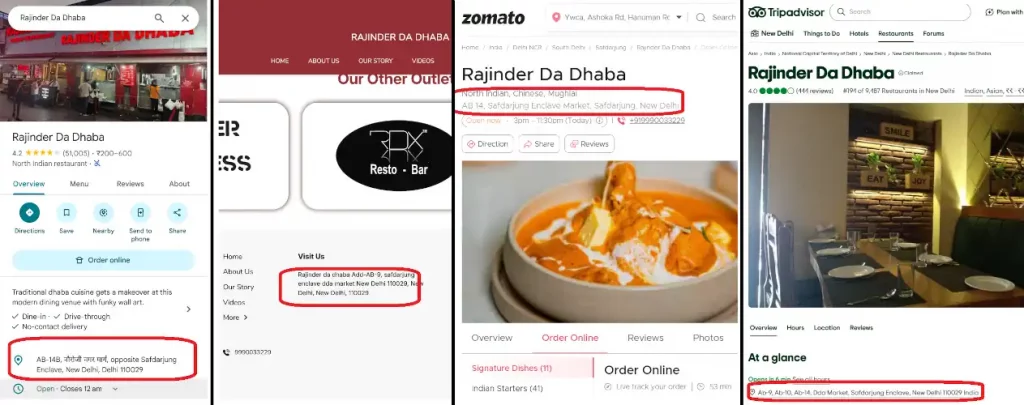
NAP stands for Name, Address, and Phone Number. These three details must be identical across your website, Google Business Profile (GBP), Zomato listing, Justdial, food blogs that mention you, and any other directory. Even small differences like “Sector 18, Noida” versus “Sector-18 Noida” can confuse Google and weaken your local search ranking.
Review Management
A consistent stream of genuine reviews is one of the most powerful local SEO signals. Build a simple system. After a positive dine-in experience, your staff asks the customer to leave a Google review. A well-worded card with a QR code on the bill works like a charm. For delivery, a note in the packaging with a review link adds a personal touch.
Structured Data and Food Photography
Adding schema markup (structured data) to your website tells Google exactly what your business is, what cuisines you serve, what is your price range, and what are your operating hours.
Paired with professional food photography (properly lit, styled images), your website begins to perform like a real marketing asset rather than a digital placeholder.
A small tip is to check with them on call/WhatsApp if they have received their order and are happy. Process a refund if they are not satisfied with the delivery.
All this structure makes it easier for the customer to trust you. Customers get better prices when they order from your restaurant directly. They are ordering from these platforms because they TRUST them with a good experience.
Social Media Marketing For Restaurants That Actually Works
Social media marketing for restaurants in Delhi needs to earn customers about building a consistent, recognisable presence that keeps your restaurant in the mind of someone who ate with you six weeks ago and is deciding where to book for the weekend.
Instagram and Reels
Instagram is where Delhi’s food culture lives. Hauz Khas Village restaurants have built cult followings almost entirely through Instagram. Reels are the highest-reach format on the platform today. A behind-the-scenes video of your chef plating a signature dish, a time-lapse of your kitchen during a Friday rush, or a 30-second tutorial using one of your signature ingredients can reach thousands of potential customers at zero cost.
- Post 3-4 times per week, mixing Reels, carousels, and Stories
- Use location tags for your neighbourhood and area, not just Delhi
- Engage with food hashtags that are local like #DelhiFoodScene, and #DelhiEats
- Respond to every comment and DM within 24 hours
Influencer Collaborations
Delhi has a thriving community of food content creators across Instagram and YouTube. A single collaboration with a mid-sized food influencer (50,000–200,000 followers) who is trusted by Delhi audiences can bring in more genuine new customers than a month of paid ads, and often at a lower cost.
Focus on authenticity over follower count. According to a Food Brand Report 2026, 70% of the participants trusted influencer recommendations. A creator who genuinely loves your food and their audience trusts their recommendations is worth much more than a large page doing a generic paid post. Pick your influencer wisely.
Festival and Seasonal Campaigns
Most small businesses do not fully appreciate the value of perfectly-timed campaigns.
Delhi’s restaurant calendar has natural peaks – Diwali, Navratri, Eid, Christmas-New Year, and Valentine’s Day. Beyond these, other events like Lohri, Karwachauth, Durga Pooja, Chhat Pooja, Independence Day, and more can provide timely hooks for content. Plan campaigns 3-4 weeks in advance, build anticipation through Stories and posts, and offer limited-time menu items that give people a specific reason to visit during that window.
User-Generated Content
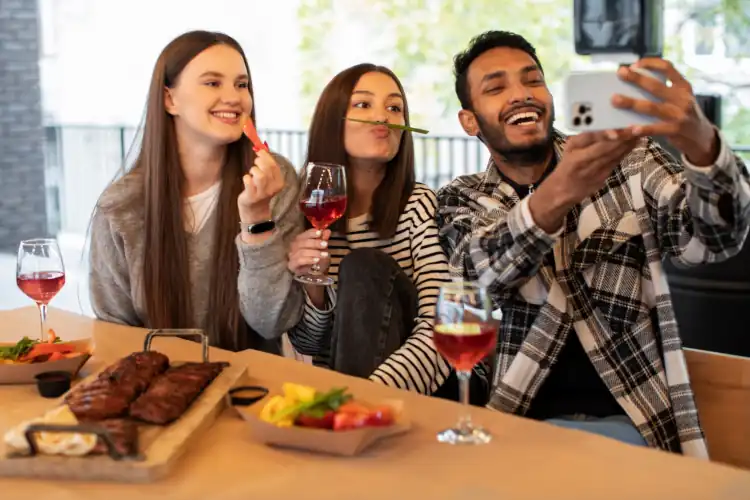
Encourage customers to tag your restaurant in their posts. Repost their content (with permission) on your own profile. This serves two purposes:
- It provides you with authentic, free content
- It signals to your audience that real people enjoy eating at your restaurant
This is a more persuasive message than any ad copy you could write yourself.
Google Ads for Restaurants
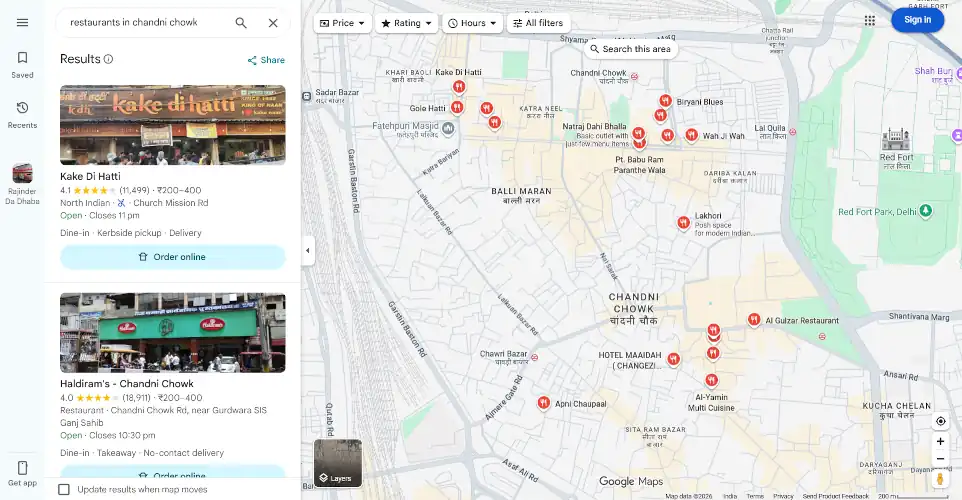
Only after organic search and social media are in place, Google Ads for restaurants become a precise, controllable tap for new customers. Unlike aggregator platform ads where you are competing for placement alongside 50 other restaurants in your category, Google Search Ads put your restaurant in front of someone actively searching for what you serve right now.
Search Ads
Target high-intent queries like “restaurants open now near me,” “best North Indian food in Rohini,” or “corporate lunch delivery Noida.” These searches come from people who are ready to eat. Your conversion rate on these clicks will be significantly higher than any awareness campaign.
Local Service Ads
Google’s Local Ads appear directly on Google Maps when someone searches for restaurants nearby. For a restaurant with a well-maintained GBP, these can be activated at relatively low cost and generate walk-in traffic.
Performance Max Ads
Performance Max campaigns use Google’s machine learning to serve your ads across Google Search, YouTube, Maps, and Gmail. They are useful for restaurants looking to scale reach without managing multiple campaigns separately.
Budget and Branded Keywords
Start with ₹300–₹500 per day. Bid on your own restaurant name as a branded keyword. It sounds counterintuitive, but if you are not doing it, a competitor might be. Track which campaigns are generating calls, direction requests, and website visits rather than optimising purely for clicks. A click that does not result in a visit or order is worthless.
Email and WhatsApp Marketing
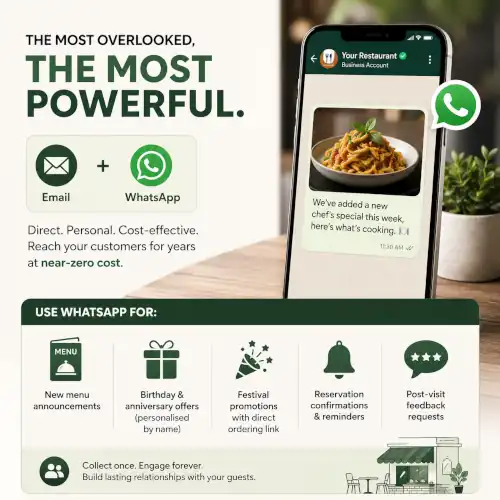
The most underused marketing channels in the Delhi restaurant industry are also the most direct – email and WhatsApp.
Once you have a customer’s contact detail, collected through a Wi-Fi sign-in, a direct order, or a loyalty card, you can reach them at near-zero cost for years.
WhatsApp Business for Restaurants
A WhatsApp Business account with a restaurant catalogue, quick-reply templates, and a broadcast list for your regulars is a powerful retention tool.
Send a message like this to your 200 loyal customers on a slow Tuesday: “We’ve added a new chef’s special this week, here’s what’s cooking.” You will see tables fill in a way that no boosted Instagram post can match.
You should use WhatsApp for:
- New menu announcements
- Birthday and anniversary offers (personalised by name)
- Festival promotions with a direct ordering link
- Reservation confirmations and reminders
- Post-visit feedback requests
Loyalty Programmes and Repeat Customer Campaigns
Don’t overcomplicate your loyalty programmes. Offer simple digital loyalty offers like:
- Ten orders earns a free dessert
- Every fifth visit gets a complimentary starter
- Every birthday girl/boy gets a free cake/dessert
Such offers do not require expensive software. It requires a system for tracking and a reason for customers to keep coming back. You can even track such offers on an Excel sheet or a more user-friendly app.
Segment your customer database by visit frequency and average order value, and send different messages to regulars, lapsed customers, and first-time visitors. A “we miss you” offer to a customer who has not ordered in 45 days has a surprisingly high redemption rate.
Measuring What Actually Matters
The most common mistake restaurants make with digital marketing is tracking the wrong metrics. Follower counts and post likes are easy to measure but rarely correlate with revenue. Focus instead on metrics that connect directly to your business outcomes.
| KPI | What It Measures | Why It Matters |
|---|---|---|
| 🛒 Direct Orders | Orders placed through your website or WhatsApp | Every direct order saves 25-30% revenue in aggregator fees |
| 📍 Google Ranking | Position for your key local keywords | Higher rank = more organic, free traffic |
| 💰 Cost Per Acquisition | Total ad spend ÷ new customers acquired | Tells you your true marketing efficiency |
| 📈 Return on Ad Spend | Revenue generated per rupee of ad spend | Ensures paid campaigns are profitable |
| ⚡ Conversion Rate | % of website visitors who place an order | Reveals whether your site converts or leaks |
| ❤️ Customer Lifetime Value | Average total spend across all visits | Justifies investment in loyalty and retention |
| ⭐ Review Velocity | New reviews per month on Google | Directly impacts local search ranking |
Review these numbers monthly, not daily. Daily fluctuations lead to panic decisions. Monthly trends tell you whether the strategy is working and where to adjust.
Swiggy and Zomato Are a Channel, Not a Strategy
The restaurants that will define Delhi’s food scene over the next decade will not be the ones with the highest ratings on aggregator apps. They will be the ones who build a strong brand, a website that earns trust, a Google profile that ranks, a social media presence that people actually engage with, and a customer database that makes every new menu launch feel like an event.
Digital marketing for restaurants in Delhi is not about abandoning Swiggy and Zomato. It’s about using them for what they are good at – discovery and convenience for first-time customers. But invest equally in channels that you own like your website, your Google presence, your WhatsApp list, and your social media. These are the channels that compound over time and cannot be taken away at the whims of a third-party platform.
A customer who finds you on Zomato and then follows you on Instagram, signs up for your WhatsApp broadcasts, and eventually orders directly from your website is your ideal customer. They are worth ten times more over their lifetime than the customer who orders only through Swiggy or Zomato.
That customer relationship is built through consistent, smart digital marketing. And it starts with a decision to treat your restaurant’s digital presence as seriously as you treat your kitchen.
Frequently Asked Questions
Ready to build a digital presence that works for your restaurant, and not just for a platform? MagicDart can help your restaurant get direct orders, build loyal customer bases, and reduce dependence on aggregator commissions. Call us at +91-79869-10830, email us at [email protected], or drop us a message here.

Leave a Reply