
Search Everywhere Optimisation: Why Google Is No Longer Your Only Search Engine
Google isn’t dying. But it’s certainly not the undisputed czar of search anymore, as SEO is rapidly evolving into search everywhere optimisation.
A few years ago, almost every online question began the same way: open Google, type keywords, click a blue link to your online destination.
Today, someone looking for the best coffee grinder might ask ChatGPT or Claude or Perplexity. There’s Google’s Gemini too, but it does not enjoy the same monopoly as Google Search, at least for now.
It is interesting to note that Google’s AI Overviews (AIOs) reach over 2 billion users. While Google Search left users to evaluate the results, AIOs are generating an answer for their exact query.
The internet is certainly searching. It simply stopped searching in one place.
And this shift should change everything about how brands should think about visibility. It’s time for brands to move from Search Engine Optimisation to Search Everywhere Optimisation.
“Search” Has Become A More Immersive Experience
For years, marketers treated Google as the front door to the internet. It was a reasonable assumption because it was mostly true.
But AI has changed the experience people expect. Instead of sorting through ten blue links, users increasingly want answers, summaries, recommendations, conversations, videos, and real opinions.
The result is a fragmented search ecosystem where different platforms solve different problems. There is a distributed authority that has returned to search.

When someone wants a quick answer, an AI search engine like ChatGPT, Perplexity, or Bing AI can provide a summary in seconds. There is no need to open five tabs and piece together information manually.
When someone wants to learn a skill, YouTube often delivers a better experience than a written article. A video tutorial can show what hundreds of words struggle to explain.
When users want real-world opinions, they increasingly turn to Reddit, LinkedIn, or niche communities. Trust has become a major factor in search behaviour. People want to know what other users, customers, and experts actually think, not just what a brand says about itself.
For product discovery, marketplaces like Amazon and Flipkart have become search engines in their own right. Shoppers often begin their journey there because that’s where purchasing decisions ultimately happen.
Search hasn’t become fragmented by accident. Users are simply choosing the platform that provides the fastest, most trustworthy, and most useful answer for the task at hand.
What Search Everywhere Optimisation Means for Businesses?
Let’s first get one thing clear – Search Everywhere Optimisation (SEvO) does not demand that you be active on every platform. It means quite the opposite. Be present only where your customers naturally search for information.
Let’s say you are a frozen food brand trying to find its first customers through digital marketing. When you research your customer or ideal customer profile, you find that they discover you on YouTube or Instagram Reels. If they get interested, they might search more about you on ChatGPT or Bing AI. They might check real reviews on Amazon. And finally, they may visit your website again through Google. It’s a journey across multiple platforms that your customer is likely to use.
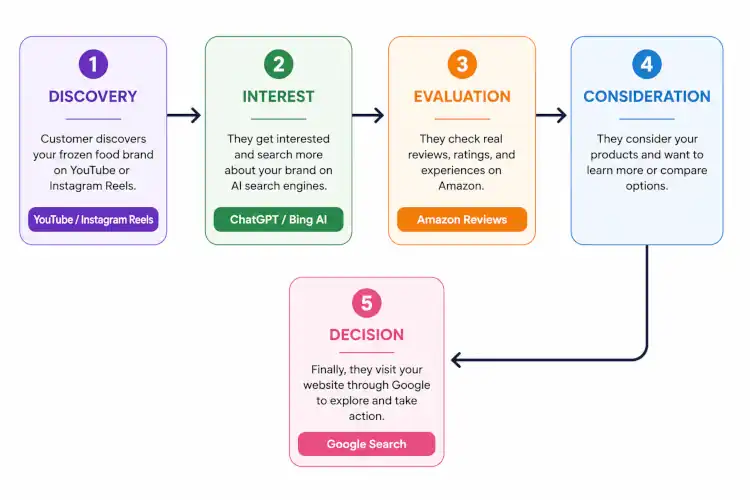
So, your brand doesn’t need to be everywhere, but should be present everywhere your customer is likely to be.
Let’s understand how SEO (Search Engine Optimisation) evolved to SEvO in this new funnel.
Since Google is not the first step of the search, just ranking higher won’t be enough. Today, effective SEO Optimisation services should also consider where your audience seeks answers, recommendations, reviews, and expertise beyond traditional search engines.
In the age of AI and distributed search, visibility isn’t measured by where you rank on Google alone. It’s measured by how easily customers can discover and trust your brand, wherever they choose to search.
How Should Businesses Adapt to this New Era of Search Everywhere Optimisation?
In the evolving context of SEvO, businesses must shift from thinking in terms of Google rankings to thinking in terms of visibility.
Traditional SEO focused on metrics like keyword rankings, organic traffic, and click-through rates, have degraded into vanity metrics. While these remain important, they only tell a part of the story. If your audience is discovering your brand through AI search engines, YouTube, LinkedIn, Reddit, or industry-specific communities, you need a broader set of metrics.
Instead of asking, “Where do we rank?”, businesses should ask, “Where are customers discovering us?” As your visibility extends beyond Google, your measurement framework should evolve as well. Here are the metrics that matter most:
| S.No. | Metric | What to Look For |
|---|---|---|
| 1. | Branded Search Volume | Track how often people search for your company or brand name. An increase in branded searches indicates growing awareness and trust. It is often a result of being discovered through AI search, social media, podcasts, PR, or industry communities. |
| 2. | Referral Traffic by Platform | Monitor traffic coming from sources like LinkedIn, Reddit, YouTube, Bing AI, ChatGPT referrals (where available), and other platforms. This helps identify where your audience is discovering your brand and which channels deserve greater investment. |
| 3. | Brand Mentions and Share of Voice | Measure how often your business is mentioned across blogs, forums, news sites, social media, and industry publications. The more credible sources reference your brand, the stronger your overall digital authority becomes. |
| 4. | Engagement Quality | Don’t just count likes and views. Look at comments, shares, saves, watch time, and meaningful discussions. These metrics reveal whether your content is genuinely resonating with your audience rather than simply being seen. |
| 5. | Conversions by Discovery Channel | Not every platform drives the same type of customer. Compare enquiries, demo requests, purchases, or leads generated from Google, AI search engines, social media, YouTube, and referral sources. You may find that a platform delivering less traffic produces significantly higher-quality leads. |
How to Get Started with Search Everywhere Optimisation?
Search Everywhere Optimisation brings home an important message – Search Didn’t Shrink, It Multiplied. So, SEvO requires you to be intentional about where you invest your efforts.
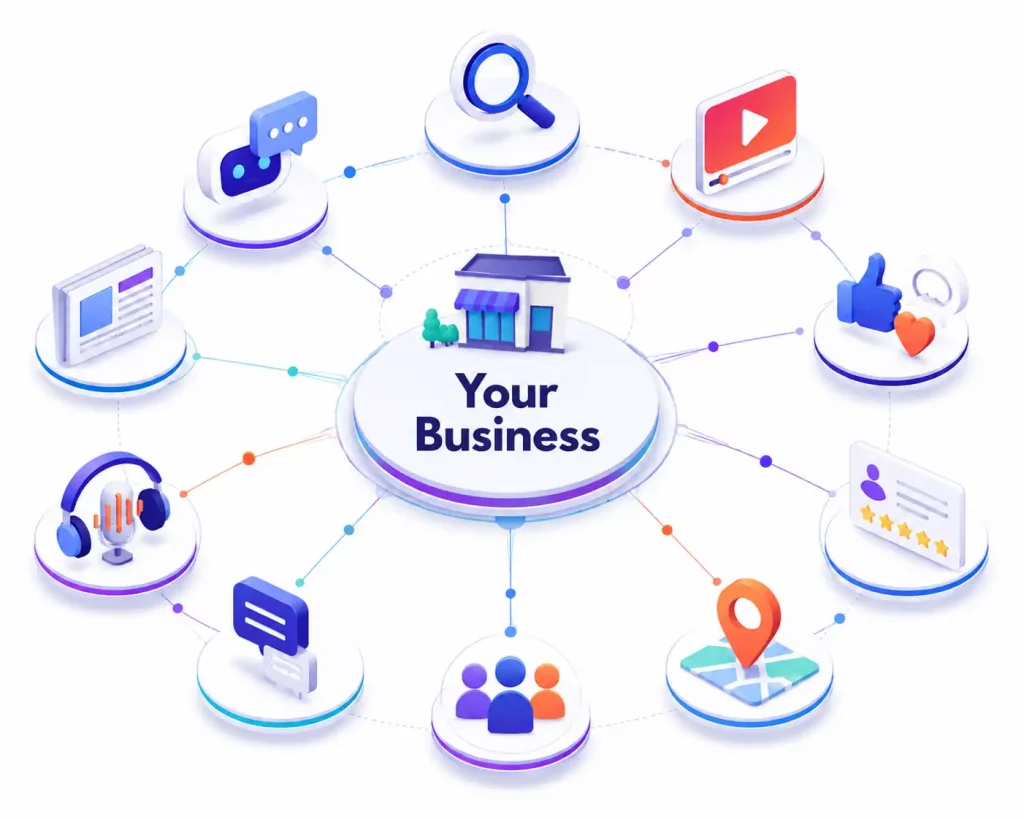
Start by mapping your customer’s search journey. Where do they go to discover new products? Where do they seek recommendations? Where do they compare options before making a purchase? The answers will differ depending on your industry.
Next, repurpose your content instead of creating something new for every platform. A blog post can become a LinkedIn article, a YouTube video, an Instagram carousel, and a series of short-form videos. This allows you to build visibility across multiple channels without multiplying your workload.
Finally, think beyond publishing content. Encourage customer reviews, participate in industry discussions, answer questions on community platforms, and build relationships with creators and publications in your niche. Every credible mention strengthens your digital presence and increases the likelihood of your brand being discovered.
The businesses that succeed won’t necessarily be the ones creating the most content. They’ll be the ones making it easiest for customers to find and trust them, wherever the search begins.
Frequently Asked Questions
Ready to build a digital presence that is aligned with your customer’s journey? MagicDart can help you identify your ideal customer profile, refine their journeys, and then implement a plan for search everywhere Optimisation. Call us at +91-79869-10830, email us at [email protected], or drop us a message here.
Leave a Reply