
Website Structure for SEO: Blueprint for Search Engine Rankings, UX, and AI Search Visibility
Imagine yourself walking into a supermarket with no signs, no aisle markings, and scattered products? It would be a nightmare to find anything, right? Unfortunately, some websites are built exactly like that! Website structure (also known as site structure or website architecture) is the foundational system by which a website’s pages, URLs, navigation menus, and internal links are organized and interconnected. It helps humans, search engines, and AI crawlers find what they’re looking for.
A meticulously engineered website structure transforms a scattered collection of web pages into a unified, topical ecosystem. It directly governs how link equity flows across your domain, how efficiently search bots index your content, how intuitively users discover products or answers, and how effectively generative AI engines synthesize your brand’s expertise. In this foundational guide, you’ll learn why site structure matters and how to create a solid website structure for SEO and GEO.
Key Takeaways From This Site Structure Guide:
- What site structure is and why it matters?
- Types of common website structures
- Components of a Site Structure
- How to Create High-performance Site Structures for SEO and GEO
What is Website Structure?
Site structure is the organizational design and interconnection of all content on a website for the purpose of intuitive user access, navigation, and easy crawlability and indexing for search engines and AI crawlers.
Website Structure Affects Your:
- Search Engine Rankings (SEO, specifically)
- User Experience (UX)
- Crawlability and AI citations (Generative Engine Optimization)
At its core, website structure is the structural application of Information Architecture (IA). It encompasses the systematic grouping of related content, the hierarchical arrangement of pages from macro-categories down to granular subtopics, and the technical navigation paths that bind these pages together.
Modern search engines no longer evaluate web pages as isolated entities. Instead, they evaluate the contextual relationship between pages across your entire domain. A site structure gives the crawlers additional context about how a particular piece of content fits into the broader context of your website.
Homepage
Main EntryCategory A
SectionPage
APage
BCategory B
SectionPage
CPage
DImportance of Site Structure for SEO, GEO, and UX
Your site structure is one of the most important foundational pillars of the website. It affects every aspect of your website’s effectiveness, right from user experience to visibility. Here’s how:
1. It Helps Users Find What They’re Looking For
When visitors arrive on your website, they should “feel” confident about where they are, how to navigate your website, and where they can find more relevant information in there. That’s what a good site structure does.
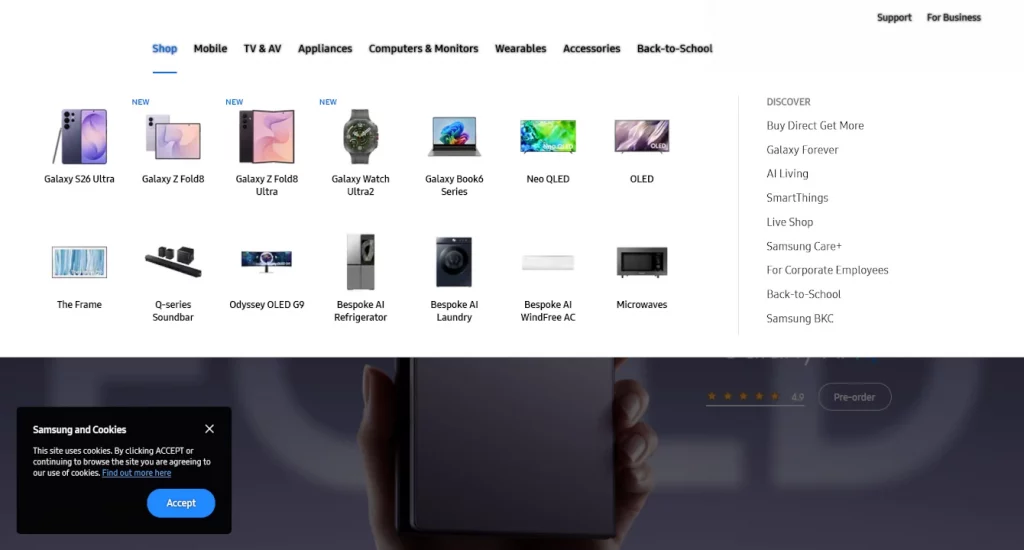
On the other hand, a poor site structure leaves them completely confounded, forcing them to leave your website. Search engines like Google track this using a metric called bounce rate. An average website has a bounce rate of 40% according to Backlinko, although that number varies significantly depending on the industry. A high bounce rate tells search engines that your website isn’t what your audience is looking for. Heeding those signals, Google ranks your content lower and lower.
Likewise, other metrics like dwell time, sessions per visit, etc. are all affected by a poor site structure. And they all signal poor user experience (U/X).
2. It Helps Search Engines Find Your Content and Index It
How do you think search engines like Google find your content? Just like we have maps and road signals for navigating and finding places when driving, so do websites. Here are some of the website signals that help crawlers discover various pages that exist on your website:
- XML sitemaps
- Breadcrumbs
- Navigation menus
- Categories
- Sections
- Internal links
Without such markers, your webpages may never get discovered by search engines and AI crawlers. Such pages end up “orphaned.” They don’t get indexed, ranked, or cited, wasting your SEO and GEO efforts altogether.
3. It Optimizes Crawl Budget and Crawl Depth
Search engine bots (such as Googlebot, ClaudeBot, GPTbot, etc.) do not possess infinite resources when discovering web pages. They assign every domain a finite “crawl budget,” which is the number of URLs the crawler will analyze during a given pass.
If your site architecture is overly deep, disorganized, or contains thousands of unmanaged dynamic URLs, search bots waste their allocated budget on low-value pages. Consequently, new content updates or core revenue-generating pages may remain undiscovered and unindexed for weeks.
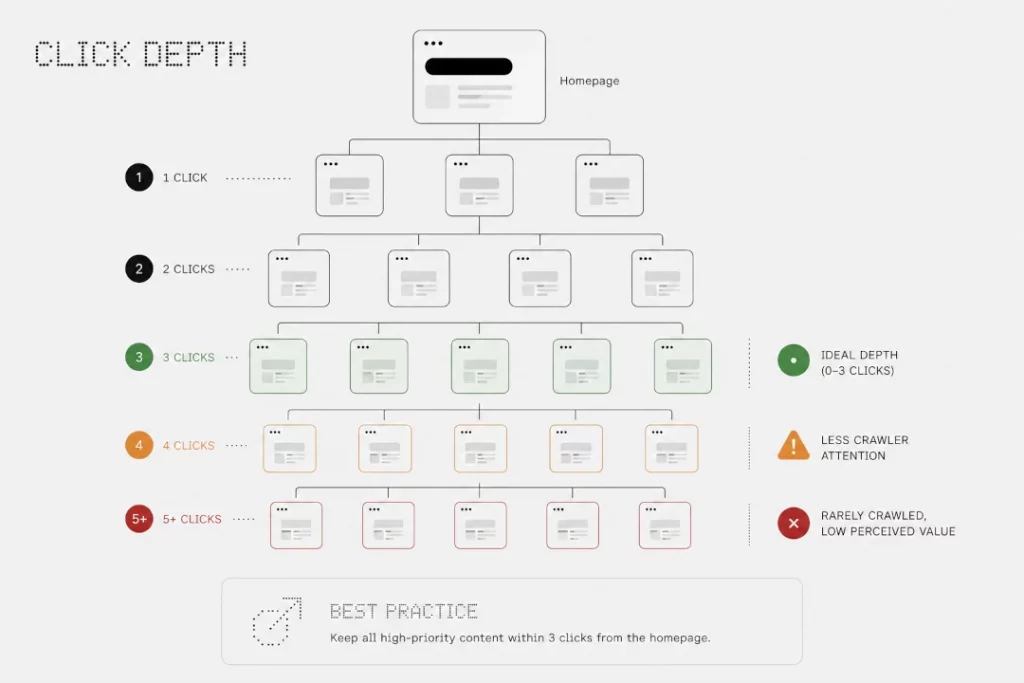
Crawl depth represents the exact number of clicks required to navigate from the homepage to any target URL. Best practices dictate that all high-priority content must sit at a click depth of 3 or less from the root directory. Pages buried at a depth of four or more clicks receive significantly less crawler attention and are frequently perceived by algorithms as low-value supplementary content.
4. It Distributes Link Authority (Link Juice) Through Webpages
Domain authority and backlinks naturally accrue to external-facing assets, most notably your homepage and viral pillar guides. Internal links act as conduits that distribute this accumulated authority throughout your site hierarchy. Historically, this authority is conceptualized as “link equity,” “link juice,” or “PageRank.”
A well-planned structure ensures that authority naturally cascades down from your root domain to category hubs, and ultimately to deep-level conversion pages or supporting articles. Without a clear structural pathway, your internal link equity becomes fragmented, leaving deep pages underpowered in competitive SERP rankings.
Even blogs and landing pages with strong authority can pass some of their authority to “linked pages” and boost their rankings and drive more traffic to them.
5. It Reduces Keyword Cannibalization
When a website lacks a logical information structure, content creators inevitably publish multiple pages covering overlapping topics. This creates internal keyword cannibalization, where your own URLs compete against each other in search engine indexes.
A structured architecture resolves cannibalization by creating explicit thematic homes for every query. Broad “head” terms are assigned to high-level parent pages or categories, while specific long-tail queries are routed to dedicated supporting subpages that link back to the parent hub.
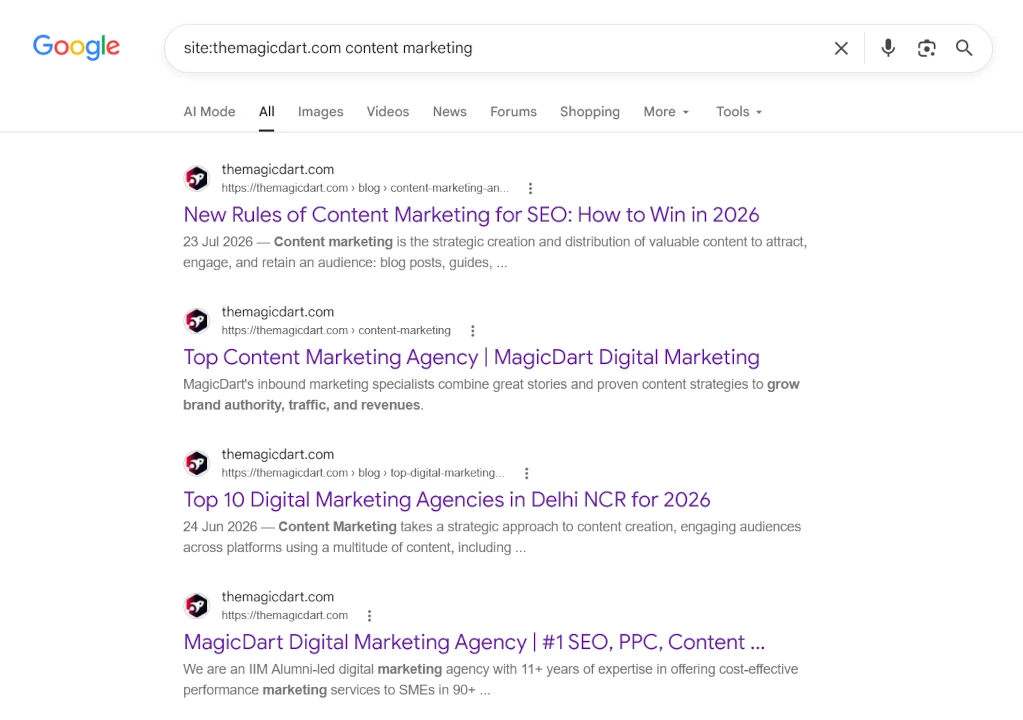
There’s an easy way to find potential keyword cannibalization that could be hurting your website. Use the “site:” operator on Google and your ranking keyword to find possible cannibalization. Here’s an example from our website:
6. It Gives Search Engines and AI Crawlers Additional Context on Webpages
Search engines and LLMs get additional context about a webpage depending on its location within the site architecture.
For instance, your ecommerce website could be selling shoes for men, women, babies, and pets. Depending on your page’s category location, URL, and even anchor text of the internal links pointing to it, search engines can determine whether the product is for men, women, babies, or pets.
Without such signals, search engines and LLMs may struggle to properly interpret, and index your pages, ultimately making it difficult for them to rank or cite properly.
7. It Helps Search Engines Generate SERP Sitelinks and Rich Results
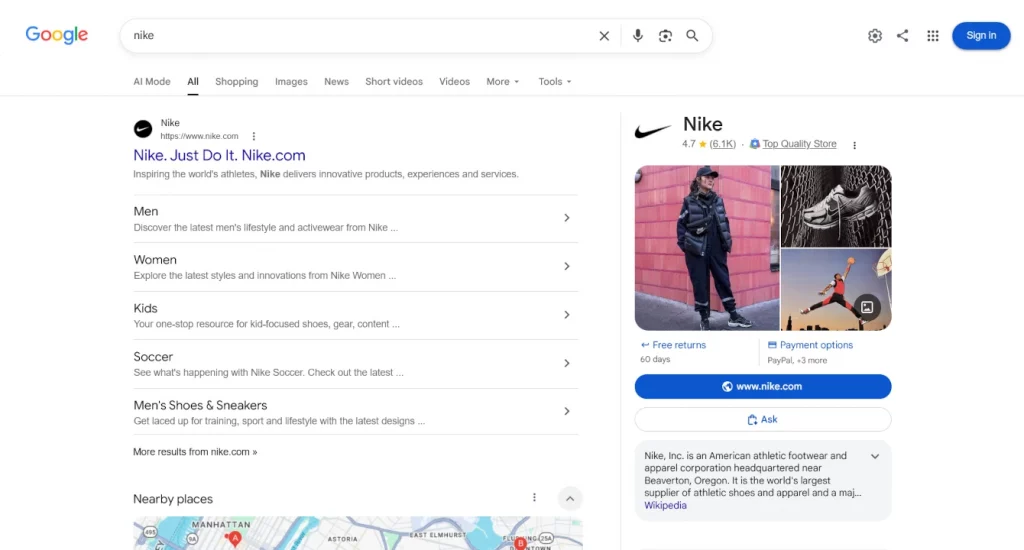
Ahrefs estimates that 12.9% of the clicks it receives from branded search are through sitelinks, the expanded link blocks displayed beneath a primary organic listing. That’s how important sitelinks are.
Google automatically generates SERP sitelinks only when a website exhibits a clear, unambiguous structural hierarchy. Sitelinks dramatically expand your organic real estate on search engine results pages, increase domain trust, and boost click-through rates (CTR) by up to 20% for Google Ads, and even higher for organic SERPs.
Types of Website Structures
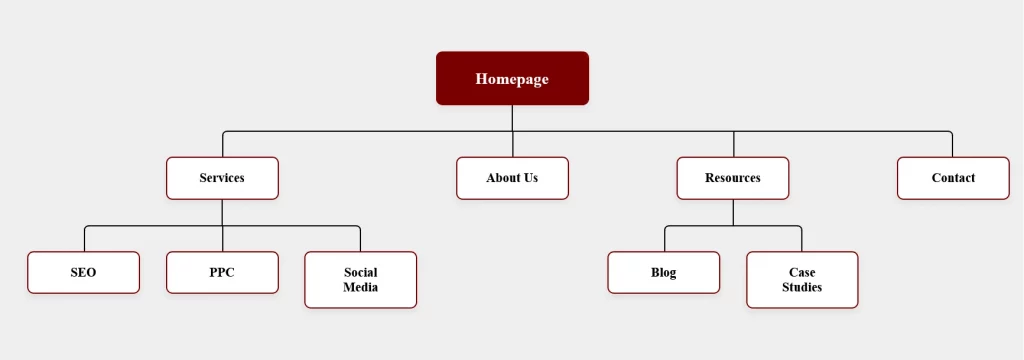
Like we discussed before, a good site structure keeps all high-priority content only 3 or fewer clicks away from the root directory, or the main page. Here’s an example of a good site structure:
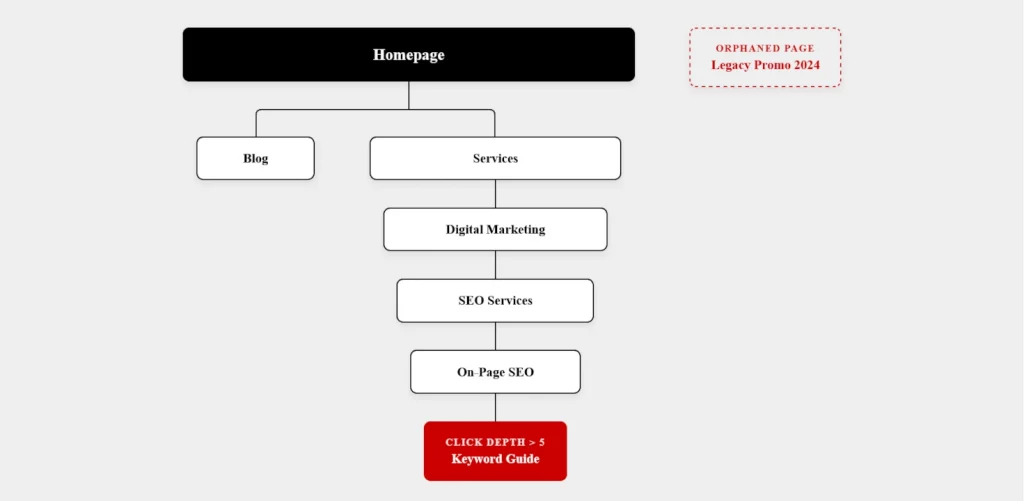
And here’s an example of a bad website architecture with many pages buried deep in the website, requiring many clicks from website users to reach them, while signaling to crawlers that the deeply buried pages aren’t “that” important.
While there’s no one-size-fits-all model for site structure, here are common approaches for various purposes and industries:
1. The Hierarchical Pyramid Site Structure: Default for Massive Websites
The hierarchical structure is the gold standard for web development and SEO. It follows a top-down pyramid design starting with the homepage at Level 1, branching into primary category hubs at Level 2, secondary subcategories at Level 3, and individual post or product pages at Level 4.
- Ideal Use Cases: E-commerce stores, large publication portals, corporate websites, multi-product enterprise platforms.
- SEO Advantages: Highly scalable; establishes logical mental models for users; provides intuitive parent-child relationships for search bots.
- Technical Risks: If unmanaged, subcategories can bloat exponentially, pushing deep pages beyond the critical 3-click threshold.
2. The Hub-and-Spoke (Topic Cluster) Site Structure: Content Marketing Workhorse
The hub-and-spoke framework organizes content around a comprehensive central pillar page (the hub) that covers a broad subject in depth. The hub links bi-directionally to multiple supporting subtopic pages (the spokes), which explore specific sub-queries in exhaustive detail.
- Ideal Use Cases: Content marketing hubs, SaaS educational academies, specialized media blogs.
- SEO Advantages: Rapidly builds competitive topical authority; concentrates link equity within specific thematic silos; ideal for capturing conversational AI search queries.
- Technical Risks: Requires continuous internal link maintenance; can become messy if spokes cross-link without structural logic.
3. The Strict Silo Architecture: For Fragmented Digital Presence
Siloing involves dividing a website into isolated thematic sections. Under a strict silo design, content within Silo A links exclusively to other pages within Silo A and back to the Silo A hub page. Cross-linking between Silo A and Silo B is strictly prohibited or kept to a technical minimum.
- Ideal Use Cases: Specialized niche affiliate portals, highly multi-industry enterprise sites, regulatory or compliance documentation hubs.
- SEO Advantages: Maximizes topical purity; prevents context dilution across unrelated verticals.
- Technical Risks: Highly rigid; degrades user experience if visitors cannot navigate naturally across related categories.
4. The Sequential / Linear Pathway Structure: Sales Funnel Hero
A linear structure guides users along a single, fixed step-by-step sequence. Page A leads strictly to Page B, which leads strictly to Page C. Webmasters exert complete control over the UX by forcing users along a predetermined pipeline of webpages.
- Ideal Use Cases: Lead-generation landing funnels, event registration flows, SaaS onboarding tours, online instructional courses.
- SEO Advantages: Controls user conversion velocity perfectly; eliminates navigation distractions.
- Technical Risks: Poor organic reach; limits the domain’s capacity to rank for broad keyword sets.
5. The Dynamic Database Matrix Site Structure: Aggregator Engine
Database-driven architectures build navigation views dynamically based on user filtering, tags, and database attributes. Rather than static folder paths, pages are generated through relational queries.
- Ideal Use Cases: Global job boards, real estate listing platforms, flight aggregators, large-scale travel booking portals.
- SEO Advantages: Efficiently handles millions of hyper-specific data combinations.
- Technical Risks: Extreme exposure to index bloat, severe canonicalization issues, duplicate content loops, and wasted crawl budget.
Components of an SEO-Friendly Website Structure
To execute a world-class site architecture, technical SEO specialists and web architects must optimize the following interconnected foundational elements:
1. Home Page
Homepage, also known as Main Page, is usually the entry point for most visitors to your website. Therefore, it helms two crucial responsibilities:
- Justification: It must quickly convey your core message, your purpose, and your relevance to the visitors. It must offer them strong and enough reasons to continue to stay on your website.
- Guidance: Your homepage must offer visitors clear navigational options to help them find precisely what they’re looking for. Whether they came with informational or commercial intent, your homepage must guide them using clear calls to action to specific pages that satisfy their intent.
2. Menu Navigation
Your website’s Main Menu lays out the structure of your entire website for visitors, giving them a highly intuitive and easily accessible path to pages they want to visit.
A genuinely useful navigation menu should display links to category and subcategory pages. Once visitors arrive on subcategory pages, additional menus should offer them clear paths to important pages.
Most websites generally make use of 3 navigational menus for both human visitors and SEO purposes:
- Header (or top) Navigation Menu: With links to all main categories and pages.
- Footer Navigation Menu: A more comprehensive menu with links to pages that couldn’t be covered in the Main Menu.
- Mobile Navigation Menu: Specifically optimized for mobile and tablet screens.
3. Categories
Categories bring organization to large websites with lots of content, product pages, and service pages. They categorize pages based on common themes like topics, niches, themes, etc. They also create logical hierarchies that make it easy for both visitors and search engines to scan and navigate the website.
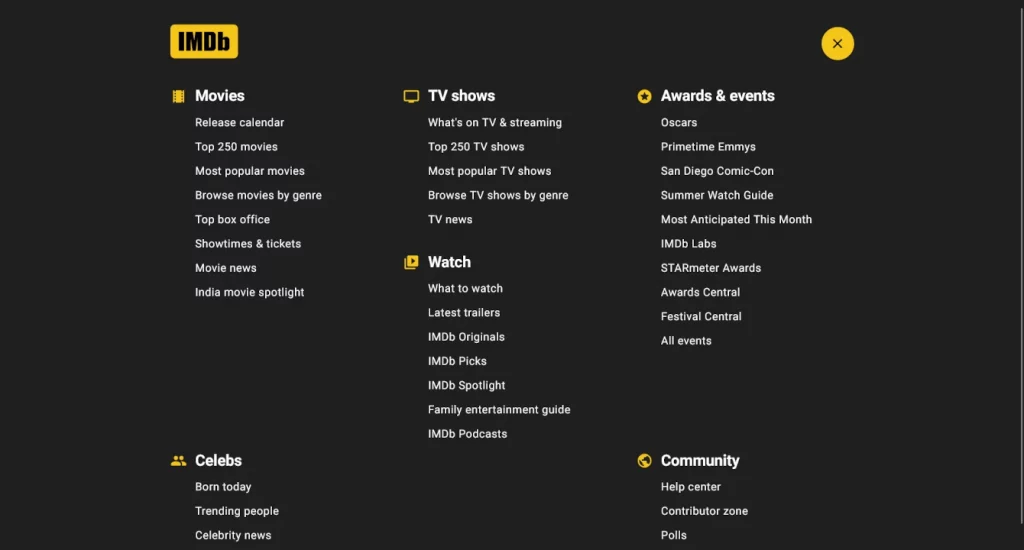
Often, category pages further splinter into subcategories when necessary. For instance, here’s the navigation menu of IMDb’s website. Observe how categories like Movies, TV Shows, Celebs, etc. branch out into their various subcategories.
4. Contextual and Internal Links
Internal links connect webpages within the same website. They guide users through your website content, establish clear connections between webpages for search engines, and distribute page authority among them.
Meanwhile, contextual links point to webpages outside the website. They offer additional context, point to sources of facts or stats you state in your content, and direct visitors to product or service pages on other business websites.
5. Content Pages
Content pages are the foundation on which the entire website structure is built. Product pages, service pages, pricing pages, FAQs, blogs, case studies, landing pages, and other types of content pages together form the flesh and bone of a website.
Not only is it critical that each of these components is precisely where it must be, the visitor must be aware of their location too. More importantly, the pages must offer visitors clear signals on “what’s next” in the form of breadcrumbs, calls to action, related content, and funnels.
6. Footers
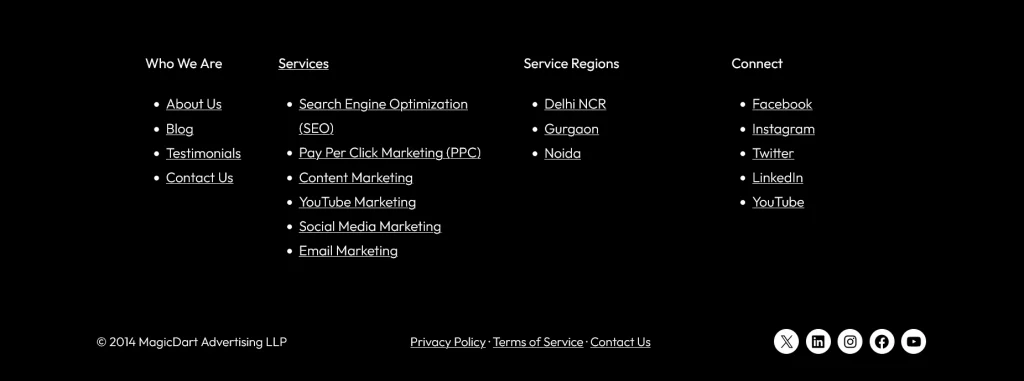
Often ignored, footers are the unsung heroes of website navigation. They offer more comprehensive information than Main Navigation menus, often including links to the Privacy Policy, Terms of Use for the website, an in-depth sitemap, social links, contact details, copyright information, and more.
Besides offering quick information to visitors, footers also help crawlers find deeper pages easily and index them.
7. Breadcrumbs
Breadcrumbs do more than just tell visitors where they are on a website. It allows them to navigate up the hierarchy chain, and access related content without getting lost. Internet users intuitive understand how breadcrumbs work and use them to navigate websites with ease.
8. URL Structure
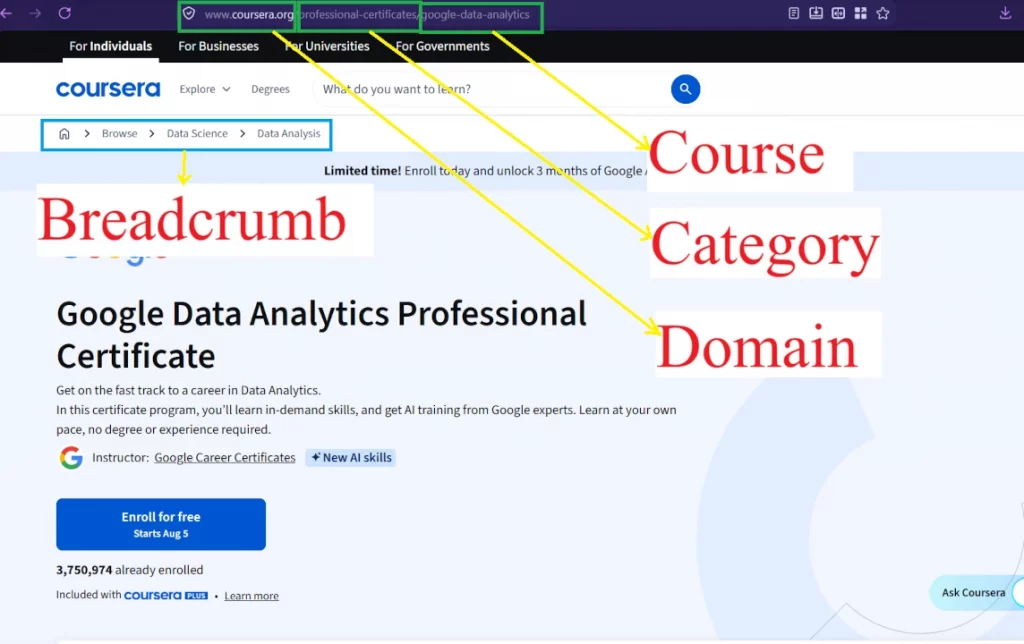
URLs provide search engines clear signals about site structure and the location of a webpage in the site hierarchy. In fact, a meticulously designed URL structure achieves two objectives. Like breadcrumbs, URLs can help visitors navigate up the hierarchy chain. But more importantly, they help search engines understand how each page fits into the site’s broader structure, under respective categories.
Site Structure Best Practices for SEO
1. Structure URLs for Optimum Information Relay
URL structures act as human-readable and machine-parseable location markers. Clean URL taxonomies reflect the logical hierarchy of the site folder structure. In fact, SEO-friendly URLs are among the most crucial ranking factors on search engines.
Ensure URL folder paths directly reflect parent-child positioning.
-
Optimal
https://example.com/shoes/running/hiking-shoes -
Suboptimal
https://example.com/item-ID-263821?category=12
Further, always enforce lowercase lettering, hyphen-separated word breaks (-), no special characters, and consistent trailing slash handling (/) across all environments.
2. Keep Click Depth to 3 or Lower
Click depth is the exact distance between the homepage and a target page. Maintaining a shallow structure requires deliberate engineering.
To achieve a shallow architecture on massive domains:
- Leverage wide main navigation mega-menus that link directly to primary subcategories.
- Implement contextual “Featured Hub” modules on high-level category pages.
- Utilize HTML breadcrumbs across all child URLs.
3. Use Contextual Internal Links and Optimize Anchor Texts
Your internal linking policy should be built on the foundation of these 3 pillars:
- Contextual In-Body Links: Links placed naturally within the body copy carry significantly higher SEO authority than sitewide footer or sidebar links.
- Descriptive Anchor Text: Never use generic anchor text like “click here” or “read more”. Use descriptive anchor text that includes variations of the target page’s core entity keyword.
- First Link Priority: When two internal links point to the same destination URL from a single source page, search algorithms primarily evaluate the anchor text of the first link in the HTML code.
4. Use Categories and Tags Strategically
Taxonomy misuse is one of the leading causes of search performance degradation on CMS platforms like WordPress.
Categories are like Table of Contents. They establish the primary vertical hierarchy. Every page or article must belong to one primary category. For instance, MagicDart has categories like SEO, PPC, Email Marketing, etc.
Tags, on the other hand, work like a book index. Tags represent horizontal micro-topics that cross-connect content across different categories. Tags are non-hierarchical and often transcend categories. We often use tags like checklist, guide, beginner, advanced, etc.
5. Optimize Breadcrumbs
Breadcrumbs are secondary visual navigation chains, typically rendered at the top-left of a web page, that display the user’s path back to the root directory.
Breadcrumbs serve three essential roles:
- They lower bounce rates by providing users with instant backtrack paths.
- They pass structured contextual internal link equity back up to parent hubs.
- When marked up with JSON-LD schema, they replace standard URLs on search engine results pages with clean, clickable breadcrumb paths.
6. Keep Technical Sitemaps and Crawl Directive Files Updated
- XML Sitemaps: An XML sitemap is a machine-readable document listing all canonical, indexable URLs on a domain. Sitemaps should strictly exclude redirected URLs (301), canonicalized variants, non-indexable pages (noindex), and broken links (404).
- Robots.txt Optimization: Use robots.txt to block search crawlers from entering non-public, high-volume directory loops (e.g., administrative panels, internal site search query parameters /search?q=, cart/checkout pathways) to protect crawl budget.
Site Structure Best Practices for GEO and AI SEO
1. Make Webpage Structures Machine-Readable
Human users process web pages visually, relying on layouts, white space, styling, and navigation bars. AI language models parse web pages structurally by reading underlying HTML heading tags (H1, H2, and H3), code blocks, and structured metadata. This will help AI models to parse the entity relationships.
2. Take an Inverted Pyramid Approach to Content Formatting
40-50 words snippet-ready block designed for quick extraction and immediate user value.
Detailed context, bulleted core takeaways, and technical data.
In-depth tactical workflows and comparative matrices.
To satisfy both Featured Snippets and AI Overview synthesis, individual content pages must adopt an Answer-First, Explanation-Second layout.
- Direct Answer Block (Position Zero Target): Directly beneath your primary H1 or H2 heading, provide a clear 40-to-50-word direct summary answer.
- Supporting Data and Breakdown: Follow the summary answer with bulleted takeaways, comparative data tables, or structured sub-steps.
- Conversational Question Headers: Frame headings as explicit questions (e.g., “How do you structure a website for SEO?”) to match natural-language queries used in conversational voice and AI search.
3. Implement Schema Markup
Schema markup converts raw HTML into structured, machine-understandable data tables. You can get relevant schema markup from schema.org. JSON-LD is the most common schema markup recommended for both AI and SEO indexing.
4. Choose the Right Multi-Regional and Multi-Lingual Site Structure Design
When expanding a website architecture to serve global audiences across multiple countries or languages, structural design determines whether your content reaches target international markets or suffers from severe duplicate content cross-contamination. Here are the 3 common site architectures for websites targeting multi-regional and/or multi-lingual audiences:
i. Subdirectories: Best for Authority Consolidation
- Structure: example.com/en/, example.com/fr/, example.com/de/
- Pros: Consolidates all domain authority, backlinks, and link equity into a single root domain; cost-effective to maintain; simplest setup for analytics and technical audits.
- Cons: Lower local trust signals in certain country markets that heavily prefer country-code top-level domains.
ii. Subdomains: Best for Decentralized Control
- Structure: en.example.com, fr.example.com, de.example.com
- Pros: Allows isolated hosting infrastructure and separate server locations per region.
- Cons: Google frequently treats subdomains as distinct web entities, diluting backlink authority across your global footprint.
iii. Country-Code Top-Level Domains (ccTLDs): Best for Localization
- Structure: example.us, example.fr, example.de
- Pros: Maximum local geographic ranking signal; highest consumer trust in regional markets.
- Cons: High operational expense; requires building domain authority from scratch for every individual ccTLD domain.
5. Implement hreflang Regional Mapping
International architectures require explicit hreflang code implementation to declare targeted language and geographic regions to search engine crawlers.
Key Components of a Properly Implemented hreflang:
- The x-default Fallback: Always include an x-default tag to automatically route unmatched international visitors to a primary global landing page.
- Bidirectional Reciprocity: Every URL pointing to an international variant must receive an exact reciprocal hreflang link back from that target URL. Missing reciprocal tags cause global indexing failures.
Key Learnings Summarized
Here’s a summary of everything we just covered:
- Site Structure Boosts SEO & GEO: Logical site structure ensures search bots index all pages within a 3-click depth of the homepage, optimizing crawl budget while reducing user bounce rates.
- Pick the Right Structural Framework: Match your site model to your business type, using a Hierarchical Pyramid for large e-commerce stores or a Hub-and-Spoke topic cluster for content hubs.
- Internal Linking Distributes Authority: Clean folder-based URLs and contextual internal links with descriptive anchor text pass link equity (PageRank) from authority pages down to deep target URLs.
- Format Content for LLMs: Use an answer-first inverted pyramid layout (40–50 word summary blocks under natural-language question headers) and JSON-LD schema to secure AI citations and Featured Snippets.
Frequently Asked Questions
Book Your Free SEO Audit to evaluate your Website Structure and GEO Readiness today! Partner with MagicDart’s SEO Architects to turn your scattered web pages into an authoritative, high-ranking growth engine.

Leave a Reply