
TOFU, MOFU, and BOFU: The Search Intent-based Conversion Funnel and Content Strategy Guide
TOFU, MOFU, and BOFU conversion funnel framework forms the bedrock of modern content marketing. However, content marketing itself is witnessing a tumultuous transformation, driven largely by LLMs and AI Overviews, which have largely killed organic SEO traffic. So, you won’t be wrong to ask, “Is TOFU, MOFU, and BOFU content-driven conversion strategy still relevant in the AI era?”
And the simple answer is: Yes!
Understand that the transition from century-old “spray-and-pray” mass advertising to a search intent-based inbound marketing did not happen overnight. The theoretical foundation existed as early as 1898, when Elias St. Elmo Lewis came up with the AIDA (Awareness, Interest, Decision, Action) model. However, it wasn’t until the 1990s and 2000s that technology made its implementation possible. Today, AI has not made intent-based marketing irrelevant. It has only changed how and where we do it.
In fact, 91% of B2B and 86% of B2C marketers use content marketing to reach their audiences, according to Smart Insights.
Key highlights of this comprehensive guide:
- It breaks down the conversion funnel content marketing framework
- Deconstructs the search intent behind every stage
- Addresses non-linear buyer journeys
- Offers an actionable content blueprint for businesses
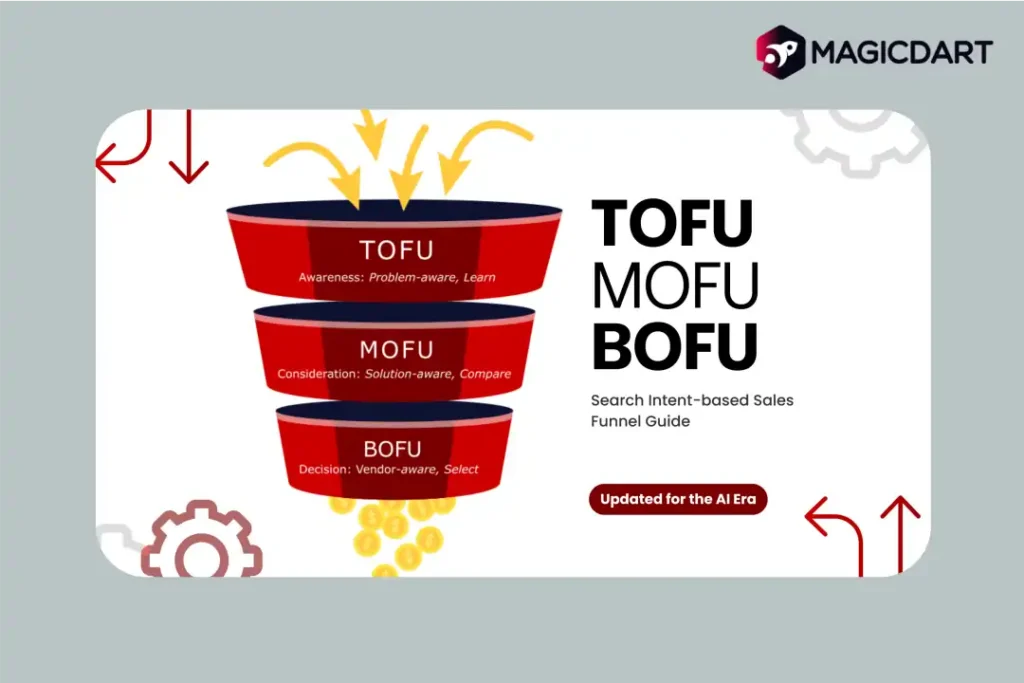
What are TOFU, MOFU, and BOFU in Marketing?
TOFU, MOFU, and BOFU represent the three core stages (top, middle, and bottom) of the marketing conversion funnel: Top of the Funnel (Awareness), Middle of the Funnel (Consideration), and Bottom of the Funnel (Decision).
Based on the classic AIDA model (Awareness, Interest, Desire, Action), the framework categorizes how prospective buyers discover challenges, evaluate viable solutions, and select specific vendors.
- Top of funnel (TOFU) is the awareness stage where potential customers begin their journey. They’re aware of the problem at this stage, but are not familiar with any products or services that will solve their problem. So, they’re trying to understand the problem’s specifics, exploring solutions, researching, learning, and identifying options.
- Middle of funnel (MOFU) is the consideration stage where prospects have a strong understanding of their problem and have a general idea of what solutions to their problem look like. In fact, they’re actively looking for and comparing various available solutions, including their features, compatibility, availability, pros, cons, reviews, and more.
- Bottom of funnel (BOFU) is the final stage in the customer purchase journey, i.e., the decision stage. Qualified leads have shortlisted potential candidates for purchasing and only need a nudge in the form of final reassurances to choose a winner. At this stage, they’re looking for pricing, proof of value, verifiable evidence of past performance, etc.
| Funnel Stage | Buyer Psychological State | Search Intent | Typical Query Types | High-Impact Content Formats | Primary KPIs |
|---|---|---|---|---|---|
| TOFU Top of Funnel | Problem-aware or symptom-aware; unacquainted with specific products or vendors | Informational | “what is,” “how to,” “why does,” “guide to,” “ways to fix” |
Educational Primers Comprehensive pillar articles, beginner primers, explainer videos, educational infographics | Impressions, organic sessions, new user acquisition, scroll depth |
| MOFU Middle of Funnel | Solution-aware; investigating methodologies, architectures, and product categories | Commercial Investigation / Exploratory Navigational | “best tools for,” “solution vs solution,” “features of,” “software alternatives” |
Evaluation Frameworks Head-to-head comparison guides, webinars, ROI calculators, buyer evaluation checklists | Time on page, return visits, email list captures, gated resource downloads |
| BOFU Bottom of Funnel | Vendor-aware; risk-averse; validating commercial terms, pricing tiers, and execution proof | Transactional / Branded Commercial | [Brand] pricing, “[Brand] vs [Competitor],” “reviews,” “free trial,” “buy” |
Validation Sandboxes Transparent pricing pages, verifiable case studies, interactive product sandboxes, demo booking flows | Sales Qualified Leads (SQLs), trial signups, customer acquisition cost (CAC), revenue |
| Post-Purchase Retention & Expansion | Value-realization; focused on onboarding, operational efficiency, and internal adoption | Advanced Informational / Navigational | “how to configure [feature],” “[Brand] API docs,” “troubleshooting [issue]” |
Implementation Portals Knowledge bases, step-by-step implementation manuals, customer community portals | Net revenue retention (NRR), churn rate, product utilization, referral volume |
Breaking Down the Sales Funnel: How Buyers Think and What Content to Create
To rank high in Google searches, your content must match what people are searching for and what they actually need at each step of their journey.
Your objective isn’t to forcibly push your audiences down the rigid traditional sales funnel, but to be relevant at each stage of their journey, so that “when” they’re finally at the decision stage, you “feel” like the natural choice.
Top of the Funnel (TOFU): Informational Discovery and Problem Identification
At the top of the funnel, prospective buyers experience an emerging friction, operational inefficiency, or knowledge gap. Crucially, they lack the technical vocabulary to categorize the solution and are usually unaware that dedicated commercial tools exist to solve their issue.
The underlying search intent is strictly informational. Users are not looking for vendor pitches, sales brochures, or pricing tiers. They want objective answers and clarity.
Cognitive State
The searcher feels the symptoms of a problem (e.g., declining team velocity, security vulnerabilities, irregular cash flow) and searches for diagnostic assistance.
Search Query Characteristics
Queries are framed around discovery questions and broad concepts. Examples include:
- “Why is employee context switching expensive?”
- “How to prevent enterprise database latency”
- “What is double-entry bookkeeping?”
Best Types of Content to Use
- Educational Pillar Guides: Broad, authoritative explainers that define concepts, unpack root causes, and lay out actionable best practices without aggressive product mentions.
- Foundational Primers and Glossaries: Concise, structured definitions optimized for position-zero Featured Snippets and AI overviews.
- Visual Infographics and Conceptual Diagrams: Easy-to-digest visual breakdowns that summarize complex frameworks or industry trends.
- Diagnostic Checklists: Downloadable or in-line diagnostic tools that help readers measure the scope of their problem.
Common Strategic Errors
Publishing biased comparison content damages trust. When a brand claims its product wins across every single feature without acknowledging legitimate trade-offs or competitor strengths, sophisticated buyers leave to find neutral third-party reviews.
Middle of the Funnel (MOFU): Commercial Investigation and Solutions Comparison
Once searchers successfully diagnose their challenge, they transition to the middle of the funnel. At this stage, prospects give their problem an official name, recognize that solutions exist, and actively evaluate methodologies, product types, and operational frameworks.
The search intent shifts to commercial investigation, often combined with exploratory navigational searches. The buyer wants to understand their options, analyze trade-offs, and establish evaluation criteria.
Cognitive State
The prospect has moved from asking “What is wrong?” to “What approaches or tools can solve this?” They are open to evaluating vendors, but they remain cautious about premature commitments.
Search Query Characteristics
Queries focus on comparisons, feature evaluations, and tool categories. Examples include:
- “Best asynchronous communication tools for distributed teams”
- “Cloud data warehousing vs on-premise servers”
- “How to choose an enterprise resource planning system”
Best Types of Content to Use
- Side-by-Side Comparison Matrices: Unbiased, balanced comparisons of competing approaches or tools, transparently highlighting pros, cons, and operational trade-offs.
- Interactive ROI and TCO Calculators: Tools that help finance and operational leaders estimate cost savings, implementation overhead, and financial returns.
- Educational Webinars and Walkthroughs: Deep-dive technical workshops demonstrating practical use cases and problem-solving tactics.
- Exhaustive Buyer Frameworks and Specification Sheets: Step-by-step evaluation rubrics that help internal buying committees structure their evaluation criteria.
Common Strategic Errors
Publishing biased comparison content damages trust. When a brand claims its product wins across every single feature without acknowledging legitimate trade-offs or competitor strengths, sophisticated buyers leave to find neutral third-party reviews.
Bottom of the Funnel (BOFU): Transactional Decision and Risk Mitigation
At the bottom of the funnel, prospects have narrowed their search to a small shortlist of vendors. The operational question changes from “What category of product should I buy?” to “Why should I select this specific vendor over the remaining alternative?”
The search intent becomes explicitly transactional and heavily branded. Searchers evaluate commercial terms, contract structures, integration capabilities, and deployment timelines.
Cognitive State
Loss aversion and risk mitigation dominate the buyer’s mindset. The decision-maker wants to ensure the purchase delivers measurable business value, secures data safely, deploys smoothly, and will not disrupt existing operations.
Search Query Characteristics
Searches are brand-centric, commercially granular, and legally specific. Examples include:
- “[Brand] pricing plans and seat tiers”
- “[Brand A] vs [Brand B] enterprise security compliance”
- “[Brand] customer reviews and case study outcomes”
- “Book a demo [Brand]”
Best Types of Content to Use
- Transparent Pricing Pages: Self-service pricing matrices that clearly outline feature tiers, usage limits, implementation fees, and renewal expectations.
- Verified Enterprise Case Studies: Outcome-driven customer stories highlighting verified quantitative metrics (e.g., “Reduced customer acquisition cost by 34% within 90 days”).
- Self-Guided Demos and Product Sandboxes: Frictionless, on-demand interactive walkthroughs that let prospects explore product interfaces without waiting for a sales call.
- Security, Compliance, and Migration Documentation: Clear breakdowns of SOC 2 Type II compliance, GDPR/HIPAA standards, and technical migration roadmaps.
Common Strategic Errors
Forcing qualified bottom-of-funnel buyers to endure lengthy forms or multi-day sales outreach schedules kills purchase momentum. High-intent prospects need transparent pricing, clear trial access, and immediate calendar scheduling options.
Post-Purchase: Keeping Customers and Helping Them Grow
Traditional funnels end at the transaction, but enterprise profitability and long-term customer value depend heavily on post-purchase retention, account expansion, and brand advocacy.
The search intent here is navigational and advanced informational. Existing customers search for educational content to maximize product adoption, automate technical workflows, and troubleshoot edge cases.
Cognitive State
The customer focuses on implementation speed, time-to-value, and user adoption across their team.
Optimal Content Assets
Technical onboarding documentation, searchable API knowledge bases, certified training academies, and exclusive customer community forums.
Core Metrics
Net Revenue Retention (NRR), churn rate, product feature adoption, customer lifetime value, and referral velocity.
How Buyers Actually Shop: Navigating the “Messy Middle”
While the classic conversion funnel is a valuable conceptual model, real-world buyer journeys rarely follow a neat, downward path. Modern B2B and high-ticket B2C journeys are non-linear, unpredictable, and iterative.
Google’s behavioral research identifies the space between initial problem recognition and final commercial selection as the “Messy Middle”. Within this environment, buyers navigate a loop governed by two continuous cognitive modes:
- Exploration (Expanding Options): The buyer discovers new angles, adds candidate solutions to their consideration list, and learns about alternative approaches.
- Evaluation (Narrowing Options): The buyer applies constraints, eliminates unsuitable options, evaluates pricing tiers, and narrows down their finalists.
The Non-Linear Buying Loop
Purchase journeys, especially in the B2B domain, are hardly ever a straight line. Gartner proposed a 6-step complex, messy, and iterative buyer journey that’s often characterized by multiple visits to each step. The following steps are derived from this framework:
- Problem Trigger: An operational challenge, unexpected business disruption, or strategic priority creates an immediate need for change.
- Solutions Exploration (Expansive): The buyer reviews broad educational resources, identifying multiple solutions and expanding their initial consideration set.
- Evaluation (Reductive): The buyer applies specific criteria, such as technical features, implementation timelines, and budget constraints, to narrow their list.
- Iterative Looping: During evaluation, a buyer might uncover a new challenge (e.g., international data residency laws), which sends them back into broad exploration to learn about that topic.
- Commercial Purchase Decision: Once all requirements are validated and final purchase objections are resolved, the buyer completes the transaction.
Cognitive Biases Influencing the Messy Middle
Google’s research, Decoding Decisions: Making Sense of the Messy Middle, describes several behavioral biases that determine how quickly prospects exit the exploration-evaluation loop and commit to a purchase:
- Category Heuristics: Clear, concise summaries of essential product features and operational specifications help buyers evaluate options efficiently.
- Authority Bias: Endorsements from recognized industry analysts, verified technical experts, and credible third-party publishers carry significant weight during the evaluation phase.
- Social Proof: Authentic user reviews, verifiable case studies, and quantitative peer testimonials reduce the perceived risk of choosing a vendor.
- The Power of Free and Immediate Availability: Offering frictionless product trials, self-service sandboxes, or instant access removes barriers and helps buyers validate capabilities without waiting for sales teams.
Websites built around rigid, one-way conversion paths struggle to retain modern buyers. Your content architecture must support horizontal movement. Bottom-of-funnel comparison pages and pricing tables should link back to technical explainers and educational documentation, giving buyers easy access to the information they need to validate requirements without leaving your site.
Budget and Resource Allocation Framework Across Organizational Stages
Treating content marketing solely as a brand-building channel obscures its direct economic impact. Measuring the return on investment (ROI) of a full-funnel content portfolio requires balancing customer acquisition value against all creation, optimization, and distribution costs.
Evaluating content solely through late-stage conversion metrics creates an incomplete picture of performance. Bottom-of-funnel pages generate the highest direct conversion rates. Still, their conversion volume is mathematically limited by the awareness and trust built upstream by top-of-funnel and middle-of-funnel assets.
Resource allocation across TOFU, MOFU, and BOFU should reflect your company’s market maturity, brand authority, and growth objectives.
| Company Stage & Profile | Core Strategic Objective | Budget Allocation by Tier | Primary Channels & Focus | ||
|---|---|---|---|---|---|
| TOFU | MOFU | BOFU | |||
| Early-Stage Category Creation | Establish initial brand discovery, build organic search authority, and earn foundational backlinks. | 60% to 70% | 20% to 25% | 10% to 15% |
Authority Inbound Informational SEO, digital PR, podcast tours, founder-led social content. |
| Growth-Stage Challenger Brand | Capture competitor search volume, generate qualified pipeline, and highlight key differentiators. | 40% to 50% | 30% to 35% | 20% to 25% |
Pipeline Conversion Solution comparison hubs, alternative pages, webinars, ROI calculators. |
| Enterprise Leader Market Incumbent | Defend market share, convert high-intent in-market demand, and expand customer lifetime value. | 20% to 30% | 40% to 45% | 30% to 35% |
Retention & Moat Branded search, client review portals, implementation documentation, communities. |
Early-stage businesses should allocate the majority of their budget (60% to 70%) to top-of-funnel assets to build search authority, capture initial organic real estate, and populate remarketing audiences.
Conversely, established enterprise brands facing high category awareness should direct up to 75% of their resources into MOFU and BOFU assets, focusing on competitive comparisons, technical validation, and conversion rate optimization.
Concrete Professional Services Example (Legal, Financial, Consulting)
Professional services require high levels of trust, personal credibility, and verified client outcomes.
Top of Funnel (TOFU)
- Target Queries: “what happens to company equity during a corporate spin-off”, “signs of workplace employment discrimination”, “understanding cross-border transfer pricing”.
- Asset Focus: Plain-English regulatory breakdowns, legal explainers, and statutory compliance checklists.
- Strategic Goal: Reassure anxious clients, demystify complex statutes, and build immediate authority.
Middle of the Funnel (MOFU)
- Target Queries: “how to choose a corporate restructuring attorney”, “mergers and acquisitions consulting fees”, “in-house vs outsourced forensic accounting”.
- Asset Focus: Partner-authored whitepapers, attorney credential guides, and firm methodology playbooks.
- Strategic Goal: Showcase partner expertise, outline firm processes, and differentiate from generalist firms.
Bottom of the Funnel (BOFU)
- Target Queries: “[Firm Name] client results”, “[Firm Name] corporate practice reviews”, “book a confidential strategy consultation”.
- Asset Focus: Anonymized case outcomes with verifiable financial recoveries, partner bios, and private consultation scheduling tools.
- Strategic Goal: Turn high-value commercial prospects into scheduled advisory consultations.
The 5-Step Funnel Content Audit: How to Find Gaps and Guide Buyers
Executing an effective full-funnel strategy requires auditing your existing content, identifying where visitors drop off, and organizing internal links to guide users down the purchase path.
Step 1: Export Your Content Inventory and Map Intent
Begin by pulling a complete list of your website URLs from Google Search Console, your Content Management System (CMS), or an organic analytics tool. The easiest way to do it is by visiting your website’s XML sitemap, which is usually available at one of the following locations:
example.com/sitemap.xml
example.com/sitemap_index.xml
In fact, you can do this for your competitor’s website too and replicate or find gaps in competitor content marketing strategy to exploit them for your gain.
Once you’ve generated a list of all your live pages, label every published page with its primary funnel stage:
- TOFU: General conceptual explainers, high-level educational posts, glossaries.
- MOFU: Solution comparisons, technical deep-dives, methodology frameworks, tools.
- BOFU: Pricing breakdowns, case studies, product pages, demo requests.
- Post-Purchase: Knowledge base articles, user manuals, onboarding documentation.
Review your traffic distribution. Many sites discover that 90% of their organic traffic lands on top-of-funnel guides, while middle- and bottom-of-funnel pages remain under-resourced and receive little internal link equity.
Step 2: Spot Stage Gaps and Conversion Drops
Track where prospective customers fall out of your digital pipeline, and find ways to boost your conversion from one funnel stage to the next.
- If your website attracts high TOFU search volume but generates few email subscriptions or product inquiries, you have a MOFU bridging gap. You need consideration-level assets, such as downloadable tools or comparison guides, to capture top-of-funnel traffic.
- If prospects read your comparison pages and view product features but fail to sign up for trials or request demos, you have a BOFU conversion gap. You need stronger risk-mitigation assets, such as verified case studies, transparent pricing details, or interactive product walkthroughs.
Step 3: Map Keywords to Intent-Driven Modifier Clusters
Structure your keyword research around the search intent modifiers unique to each stage of the funnel. Filter your keyword research tools by query structure:
- TOFU Informational Modifiers: Filter for question phrases like what, why, how, definition, overview, examples, and guide.
- MOFU Commercial Modifiers: Filter for evaluative terms like best, vs, versus, comparison, alternatives, tools, and how to choose.
- BOFU Transactional Modifiers: Filter for high-intent purchase terms like pricing, cost, enterprise plan, reviews, demo, discount, and implementation.
Step 4: Build Vertical and Horizontal Internal Linking Paths
Your internal linking strategy can make or break your content marketing efforts. Internal links guide search engine crawlers as well as your users through your site’s hierarchy. So, implement two distinct linking patterns:
- Vertical Funnel Acceleration: Guide prospects smoothly downward toward commercial intent. Add contextual links within informational TOFU posts directing readers to relevant MOFU comparison guides. Within those MOFU pages, include clear calls to action directing qualified buyers to BOFU pricing pages or product demos.
- Horizontal Intent Linking: Allow non-linear buyers to navigate laterally across related topics. Link middle-of-funnel comparison guides and bottom-of-funnel pricing pages back to technical explainers and compliance documentation, ensuring buyers can validate technical requirements without leaving your site.
Step 5: Implement Automated Tracking and Lead Routing
Track how users progress through your content using marketing automation and web analytics. Use engagement signals to trigger relevant next steps:
- When a reader finishes an introductory TOFU article, present them with an optional MOFU resource, such as a downloadable checklist or buyer framework.
- When a prospect downloads a comparison guide or visits your pricing page multiple times, route them to bottom-of-funnel assets, such as a live product demo or customer case study, rather than serving them another introductory guide.
Operational Summary: Full-Funnel Content Implementation Checklist
To turn your content strategy into an effective customer acquisition engine, follow this operational checklist:
Operational Summary: Full-Funnel Content Implementation Checklist
Follow this actionable checklist to turn your content strategy into an effective customer acquisition engine:
- Map Existing Pages to Search Intent: Audit your website inventory and tag every published URL as TOFU, MOFU, BOFU, or Post-Purchase.
- Audit Your Stage Balance: Review your content mix against your company’s growth stage to ensure you are not over-investing in raw traffic at the expense of conversion assets.
- Filter Keywords by Intent Modifiers: Use keyword research tools to isolate informational, commercial investigation, and transactional query clusters.
- Implement Snippet-Friendly Blocks: Place concise, direct-answer definitions beneath major headers to capture Featured Snippets and AI Overviews.
- Establish Vertical and Horizontal Internal Links: Build clear paths directing readers from educational guides down to commercial comparison and pricing pages, while linking laterally to technical documentation.
- Deploy Structured Schema: Mark up your content using Article, FAQPage, and HowTo JSON-LD schemas to support rich search results.
- Track Pipeline and Assisted Conversions: Measure performance using stage-appropriate metrics—tracking reach for TOFU, lead engagement for MOFU, and sales pipeline and customer lifetime value for BOFU.

Leave a Reply